- Sep 23, 2024
From Doubt to Confidence: Mastering the Art of Fearless Growth
- Kosta
- 0 comments
Introduction: Embracing the Journey from Fear to Confidence
“He who has overcome his fears will truly be free.” — Aristotle
Fear and doubt—two seemingly negative emotions that have the power to either hold us back or propel us toward unprecedented personal growth. Whether it’s fear of failure, self-doubt, or concern over what others might think, these emotions often feel like barriers, preventing us from reaching our full potential. But what if they weren’t obstacles at all? What if fear and doubt could serve as guides, showing us exactly where we need to grow and develop?
This article is designed to help you transform fear and doubt into drivers for personal progress. We will explore the roots of these emotions, delve into practical strategies to reframe them, and provide tools to build confidence through daily courage. You will also learn how setbacks, often viewed as failures, can become the stepping stones to lasting success.
This roadmap will not only offer you the psychological insights needed to understand fear but also practical actions you can take to harness its energy for growth. The journey from doubt to confidence may not be easy, but it is one worth taking—especially when you learn how to embrace your fears and transform them into tools for success.
Part 1: Understanding the Roots of Doubt and Fear
Before we can transform doubt and fear, we must first understand their origins. Fear is a survival mechanism deeply rooted in human evolution, while doubt is often a byproduct of fear—our mind’s way of telling us to tread carefully. Together, these emotions are designed to keep us safe, but in modern life, they can limit our potential if we don’t know how to harness them.
The Psychological Basis of Fear and Doubt
Fear is an ancient emotion designed to protect us from danger. The Fight-or-Flight Response, first identified by physiologist Walter Cannon, is a biological reaction triggered by the amygdala—a part of the brain that reacts to perceived threats. When you experience fear, your body prepares to either confront the threat (fight) or avoid it (flight). In early human history, this response was essential for survival. It helped our ancestors avoid predators and dangerous situations. However, in today’s world, where physical threats are far less common, the Fight-or-Flight Response often gets triggered by non-life-threatening challenges, such as public speaking, career transitions, or taking personal risks.
“We suffer more often in imagination than in reality.” — Seneca
This quote by the Stoic philosopher Seneca captures the essence of modern fear. Most of the fears we face today are psychological rather than physical. They are products of our imagination—fears of failure, judgment, or rejection. While these fears are not as immediately dangerous as the physical threats our ancestors faced, they can still have a profound impact on our ability to grow and succeed.
Doubt, meanwhile, is closely linked to fear. It arises when we question our own abilities or when we are uncertain about the outcome of a situation. Doubt can be helpful when it leads us to carefully consider our actions, but it becomes a hindrance when it prevents us from taking any action at all. Doubt is often amplified by past experiences, societal expectations, or the internalized fear of failure.
Together, fear and doubt can create a mental barrier that prevents you from stepping out of your comfort zone and pursuing growth. But with the right strategies, these emotions can be transformed from obstacles into powerful motivators.
The Role of Fear in Blocking Progress
Fear often acts like a “wall of fog”—it seems thick, impenetrable, and intimidating. Yet, as you move closer, the fog begins to dissipate, revealing that it wasn’t as insurmountable as you once thought. This metaphor captures the reality of fear in our lives. Fear can feel overwhelming, but when faced directly, it often loses its power.
The Fight-or-Flight Response, while useful in life-threatening situations, can block progress in personal and professional development. For example, consider a scenario where you’re offered a promotion at work but hesitate because you’re afraid of failing in the new role. Fear can make you question your abilities, leading to inaction and missed opportunities. This hesitation, rooted in fear, keeps you locked in your comfort zone, avoiding risks that could lead to significant growth.
While the Fight-or-Flight Response is designed to protect you, it often prevents you from pursuing new challenges and opportunities. The key to overcoming this is recognizing that fear is not a signal to retreat but a sign that you are on the edge of growth.
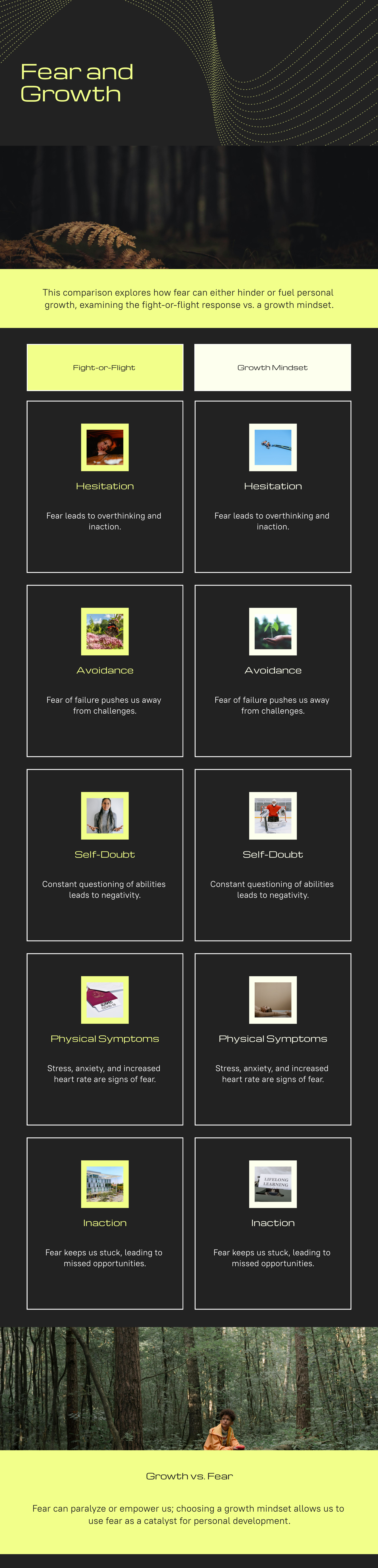
Fight-or-Flight vs. Growth Response:
Fight-or-Flight: Fear prompts avoidance, hesitation, or retreat to a safe, familiar space.
Growth Response: Fear signals that you are about to step into a new experience that will challenge you and help you grow.
By understanding the physiological and psychological roots of fear, you can begin to shift your response from one of avoidance to one of growth. Fear becomes a guidepost, signaling areas of opportunity rather than danger.
Part 2: Reframing Doubt and Fear as Tools for Growth
Although fear and doubt often feel overwhelming, they can be reframed and used as tools for personal and professional growth. The key is to change how you interpret these emotions. Instead of seeing them as reasons to avoid action, you can view them as signals that you’re on the path toward something new and valuable.
Cognitive Reframing: Turning Doubt into a Motivator
Cognitive Reframing is a psychological strategy rooted in Cognitive Behavioral Therapy (CBT). It involves changing the way you interpret negative thoughts and emotions so that they no longer hold you back. By reframing doubt, you can turn it from a source of hesitation into a powerful motivator for growth.
For example, when faced with a challenge, your immediate reaction might be to think, "I can’t do this" or "I’m not good enough." Cognitive reframing helps you step back from these automatic thoughts and challenge them. Instead of thinking, "I’m not capable," you might reframe the thought to, "This is a new challenge, and I have the opportunity to learn and grow through it."
The practice of reframing your thoughts takes time, but it is incredibly effective in reducing self-doubt and increasing your confidence. The more you practice reframing, the easier it becomes to view challenges and setbacks as opportunities for growth.
Practical Steps for Cognitive Reframing:
Identify Negative Thoughts: When you feel doubt or fear, pause and write down the thoughts that are holding you back.
Challenge the Thought: Ask yourself, "Is this thought based on fact, or is it my fear talking? What evidence do I have that contradicts this thought?"
Reframe the Thought: Replace the negative thought with a growth-oriented one. For example, "I’m not capable" becomes "This is an opportunity for me to develop new skills and prove my capability."
Take Action: Once you’ve reframed the thought, take action based on your new perspective. Acting in the face of doubt reinforces the new, positive mindset.
“The obstacle is the way.” — Marcus Aurelius
This quote from the Stoic philosopher Marcus Aurelius encapsulates the concept of cognitive reframing. Rather than seeing obstacles as barriers, we can view them as essential parts of the journey. The things we fear the most are often the very things we need to confront in order to grow.
Turning Fear into a Growth Opportunity
Fear can feel like an overwhelming force, but when reframed, it can become a tool for growth. Instead of avoiding fear, you can use it as a compass, guiding you toward the areas in your life where you need to grow the most.
Consider the metaphor of fear as a “spotlight.” Wherever the spotlight shines, it highlights an area that requires your attention and development. If you fear public speaking, for example, that fear is highlighting an area where growth is possible. The key to overcoming fear is not to avoid it but to lean into it, using it as a guide for where you need to push yourself.
Fear Exposure, a technique commonly used in therapy, involves gradually exposing yourself to the things you fear. By confronting your fears in small, manageable doses, you begin to desensitize yourself to the anxiety they cause. For example, if you fear public speaking, you might start by speaking in front of a small group of friends. As you become more comfortable, you can gradually increase the size of the audience until the fear diminishes.
Steps for Using Fear as a Growth Tool:
Identify Specific Fears: Make a list of the fears that are holding you back, whether they’re related to your career, relationships, or personal growth.
Break Down the Fear: Analyze why you fear each situation. What is the worst-case scenario? Often, the fear of the unknown is more daunting than the reality.
Face the Fear Gradually: Begin by confronting the fear in a low-stakes situation. As you gain confidence, gradually increase the difficulty.
Reflect on the Experience: After each exposure, reflect on how the fear changed. Did it diminish? What did you learn about yourself?
Each time you confront a fear, you take away some of its power. Over time, what once seemed overwhelming becomes manageable, and you build confidence in your ability to face challenges head-on.
Real-Life Examples: Embracing Fear for Transformation
One of the most powerful ways to see fear as a tool for growth is to look at real-life examples of individuals who have transformed their fears into success. Take J.K. Rowling, for instance. Before becoming the world-renowned author of the "Harry Potter" series, Rowling faced numerous rejections from publishers. Instead of letting the fear of failure paralyze her, she used it as motivation to keep refining her work. Eventually, her perseverance paid off, and "Harry Potter" became a global phenomenon.
Similarly, Steve Jobs faced a major setback when he was ousted from Apple, the company he co-founded. Rather than succumbing to self-doubt, Jobs used this failure as fuel to push his creative boundaries. He went on to found NeXT and Pixar before returning to Apple, where he transformed the company into one of the most successful in the world.
These examples demonstrate that fear and doubt are not the end of the road—they are often just the beginning. By embracing fear and using it as a motivator, these individuals were able to achieve extraordinary success.
Part 3: Building Confidence Through Daily Courage
Confidence isn’t something you either have or don’t have. It’s something you build over time through consistent, courageous action. Each small act of courage strengthens your confidence, helping you face bigger challenges in the future.
Small Acts of Courage Lead to Big Confidence
Think of confidence like a fire. Each small act of courage is a spark that helps to kindle the flame. Over time, these small sparks build into a roaring fire of confidence that can help you tackle even the most daunting challenges.
“Do the thing you fear, and the death of fear is certain.” — Ralph Waldo Emerson
This quote from Emerson speaks to the power of action in overcoming fear. The more you confront your fears, the less power they have over you. Courage isn’t the absence of fear—it’s taking action despite fear. And with each courageous action, your confidence grows stronger.
Small, manageable acts of courage are the foundation of long-term confidence. These actions might include speaking up in a meeting, setting boundaries in a relationship, or trying something new that feels uncomfortable. Over time, as you continue to practice courage, the things that once scared you will become second nature.
Framework: Courage-Building Exercises
The following framework offers practical exercises you can incorporate into your daily life to build courage and confidence:
Start Small: Identify small, low-risk opportunities where you can practice courage. This might be something as simple as initiating a conversation with someone new or sharing your ideas in a meeting. The key is to start small and build up gradually.
Reflect on the Experience: After each courageous action, take a few minutes to reflect on how it felt. Did the fear lessen once you took action? Did you learn anything new about yourself? Write these reflections in a journal to track your progress over time.
Increase the Challenge: As your confidence grows, gradually increase the difficulty of the courageous actions you take. For example, after you’ve become comfortable speaking up in small meetings, challenge yourself to lead a larger presentation or take on a leadership role in a project.
Seek Support: If fear of judgment is holding you back, seek support from a mentor or accountability partner. Having someone to encourage you and provide feedback can help you overcome the fear of criticism.
Celebrate Small Wins: Acknowledge and celebrate each act of courage, no matter how small. Confidence builds when you recognize your progress and celebrate each step forward.
By practicing these exercises consistently, you create a feedback loop: the more courageous actions you take, the more confident you become, and the more confident you become, the more willing you are to take on bigger challenges.
Techniques to Desensitize Yourself from External Criticism and Judgment
One of the biggest obstacles to building confidence is the fear of external judgment. The fear of being criticized or rejected can be paralyzing, leading many people to avoid taking risks or sharing their authentic selves. However, much of this fear is rooted in perception rather than reality. The more you expose yourself to external criticism, the less power it holds over you.
“The eyes of others our prisons; their thoughts our cages.” — Virginia Woolf
This quote from Virginia Woolf encapsulates the fear many of us feel about being judged by others. We often limit ourselves because we’re afraid of how we will be perceived. But the truth is, people are often too focused on their own lives to give much thought to ours.
Here are some practical techniques to help you overcome the fear of judgment and external criticism:
Seek Constructive Feedback: Shift your mindset from fearing judgment to seeking constructive feedback. Ask trusted colleagues or friends for feedback on your work or ideas. By reframing feedback as a tool for growth rather than criticism, you can desensitize yourself to judgment.
Gradual Exposure to Criticism: Just as with fear exposure, you can gradually desensitize yourself to external judgment by increasing your exposure to it. Start by sharing your work or ideas in a small group setting, where the stakes are lower. Over time, you can increase the size of your audience or the visibility of your work.
Reframe Criticism as Data: Instead of taking criticism personally, view it as neutral data that can help you improve. Feedback is not a reflection of your worth but simply information about your performance. By reframing judgment in this way, you separate your identity from your actions, allowing you to remain open to feedback without internalizing it as failure.
Develop Emotional Resilience: Building emotional resilience helps you stay grounded in the face of criticism. Practices like mindfulness, meditation, and journaling can help you process difficult emotions and maintain perspective. The more emotionally resilient you are, the less power external criticism will have over you.
Embrace Imperfection: Recognize that nobody is perfect, and striving for perfection can be paralyzing. Accept that mistakes are part of the growth process, and the more you embrace imperfection, the more freedom you will feel to take risks and try new things.
By consistently practicing these techniques, you will begin to desensitize yourself to the fear of judgment and build a stronger sense of confidence.
Part 4: Turning Setbacks into Stepping Stones for Success
The path to personal growth and confidence is rarely smooth. Setbacks are inevitable, but they don’t have to be seen as failures. In fact, setbacks are often the most valuable opportunities for learning and development.
Viewing Setbacks as Learning Opportunities
“The wound is the place where the light enters you.” — Rumi
This beautiful quote from the poet Rumi reminds us that setbacks and failures, while painful, often hold the key to our greatest growth. Every setback provides valuable insights into our strengths, weaknesses, and areas for improvement. The key is to shift your mindset so that you view setbacks not as roadblocks but as opportunities for learning.
For example, if you’re working toward a career goal and encounter a setback—such as being passed over for a promotion—view this as an opportunity to reflect on your approach. Ask yourself:
What can I learn from this experience?
What skills do I need to improve?
How can I approach this situation differently in the future?
By reframing setbacks in this way, you can extract valuable lessons from each experience and use those lessons to fuel your future growth.
Framework: The Growth Mindset
The Growth Mindset, a concept developed by psychologist Carol Dweck, is a powerful framework for turning setbacks into stepping stones. People with a growth mindset believe that abilities and intelligence can be developed through effort, learning, and persistence. They see challenges as opportunities to grow and view failure as an essential part of the learning process.
In contrast, individuals with a fixed mindset believe that their abilities are static and unchangeable. They are more likely to avoid challenges, give up in the face of obstacles, and view failure as a reflection of their inherent limitations.
To cultivate a growth mindset, you must shift your perspective on failure. Instead of seeing failure as a dead-end, view it as a learning opportunity. Embrace the process of continuous improvement, knowing that every setback brings you closer to your goals.
Practical Steps for Adopting a Growth Mindset:
Change Your Language: Replace fixed-mindset thoughts like "I can’t do this" with growth-oriented thoughts like "I can’t do this yet, but I can learn."
Focus on Effort, Not Outcome: Celebrate the effort you put into tasks, regardless of the result. Effort leads to improvement, even if the outcome isn’t immediately successful.
Learn from Mistakes: Instead of avoiding mistakes, welcome them as opportunities for growth. Each mistake is a learning experience that brings you closer to success.
Practice Reflection: Regularly reflect on your experiences, noting both successes and failures. Use these reflections to identify patterns of growth and areas where you can continue to improve.
Surround Yourself with Growth-Minded People: Engage with individuals who embrace a growth mindset and encourage you to take risks and learn from failures. Their support and perspective can help reinforce your own growth mindset.
Practical Steps for Learning from Setbacks
Turning setbacks into opportunities for growth requires a structured approach. Here’s how to turn failures into success:
-
Reflection Exercises: After experiencing a setback, set aside time to reflect on what went wrong and what lessons can be drawn from the experience. Journaling is an effective tool for this, as it allows you to articulate your thoughts and emotions. Ask yourself questions like:
What did I expect to happen, and what actually happened?
What factors contributed to the setback?
What can I do differently next time?
Feedback Loops: Seek constructive feedback from trusted mentors or colleagues. External perspectives can help you identify blind spots and areas for improvement. The more open you are to feedback, the faster you will grow.
Iterate and Improve: Use the insights gained from reflection and feedback to iterate on your approach. Small adjustments based on past failures can make a significant difference in future outcomes. Keep track of these iterations and continuously refine your strategies.
Celebrate Small Wins: After reflecting and adjusting your approach, celebrate even the smallest improvements. Recognizing progress—no matter how incremental—reinforces the growth mindset and keeps you motivated to keep going.
Each setback provides a stepping stone toward greater success. The more you learn from each experience, the stronger and more resilient you become.

Conclusion: From Doubt to Confidence
The journey from doubt to confidence is not a straight line. It is filled with moments of fear, hesitation, and setbacks. But it is also a journey of transformation—one that leads to personal growth, resilience, and a stronger sense of self.
By understanding the roots of fear and doubt, reframing them as opportunities for growth, and taking daily courageous action, you can build unshakeable confidence. Setbacks become learning opportunities, and every act of courage brings you closer to your goals.
Start Your Journey Today
Take your first step toward fearless growth today. Identify one fear or doubt that has been holding you back and take action. Whether it’s speaking up in a meeting, pursuing a new opportunity, or taking on a leadership role—facing your fear head-on is the first step toward building confidence.
To support you on this journey, download our Fearless Growth and Resilience Workbook. This comprehensive guide includes practical exercises, daily courage-building challenges, and strategies to help you transform fear and doubt into drivers of confidence and growth. Start your journey today by downloading the workbook and committing to your boldest goals. Also if you want to dive deeper and explore more resources on transforming fear into confidence—unlock the Complete Personal Growth and Resilience Mastery Bundle and start building the fearless version of yourself. Last, but definitely not last, please have a look at our FREE The Leadership and Personal Resilience Toolkit, and start mastering your fears and building confidence today!!
This article is part of our comprehensive guide, How to Create a Personal Development Plan. If you haven't explored it yet, be sure to check it out—it’s filled with actionable insights and links to essential resources on personal growth.
Disclaimer:
The content provided on this blog is for informational purposes only. While every effort is made to ensure the information is accurate and up-to-date, it should not be considered as professional advice. Always consult with a qualified professional before making any significant decisions based on the content. The opinions expressed are those of the author and do not necessarily reflect the views of any affiliated organizations. Any reliance you place on the information provided is strictly at your own risk. The author and website are not responsible for any losses, damages, or liabilities that may result from the use of the information in this blog.