- Oct 27, 2025
From Ego to Service: Climbing the Ladder of Growth
- Kostakis Bouzoukas
- Leadership, Personal Growth, Adult Development, Servant Leadership, Organisational Culture
- 0 comments
It’s Monday morning. A newly promoted VP scans his calendar and feels a pit in his stomach. Back-to-back meetings, project crises only he can solve, emails demanding decisions—he’s drowning. Six months into the role, he’s working harder than ever, but his team’s morale is slipping. He soon discovers that his leadership must evolve from ego to service, climbing a ladder of growth to expand his impact. Climb one rung, and your world gets larger — and so do your results.
Why It Matters
He’s not alone. Many high performers struggle after a promotion, falling into overwork and burnout. In one survey of 1,000 professionals, 77% said they had experienced burnout in their current job[1]. The root cause often isn’t a lack of talent or effort, but a failure to shift how they lead. They keep doing what made them successful as individual contributors—seeking personal achievement (ego) and mastering their craft (competence)—when the job now demands connection, contribution, and transcendent purpose. Research on adult development shows that fewer than 5% of adults reach the later stages of growth associated with truly transformational leadership[2]. In other words, most of us plateau at a level far below our potential. The Growth Ladder offers a roadmap to break through that plateau.
The Growth Ladder Framework
The Growth Ladder describes five rungs of mindset and behavior that a leader progresses through: Ego → Competence → Connection → Contribution → Transcendence. Each rung broadens one’s perspective— from focusing on me, to team, to organization, to world. Stage models are maps, not verdicts. They describe a typical journey, but real life is messy. You might straddle stages or slip back under stress. Use this ladder as a guide, not as a judgment of character or a rigid hierarchy of “better” people. Growth is always possible, and each stage simply prepares you for the next.
To summarize the framework, the table below outlines each rung’s key signals, the common trap that can stall you there, a practical “Monday Move” to spur growth, and a simple metric to track progress.
The Five Rungs of Growth: From Ego to Service
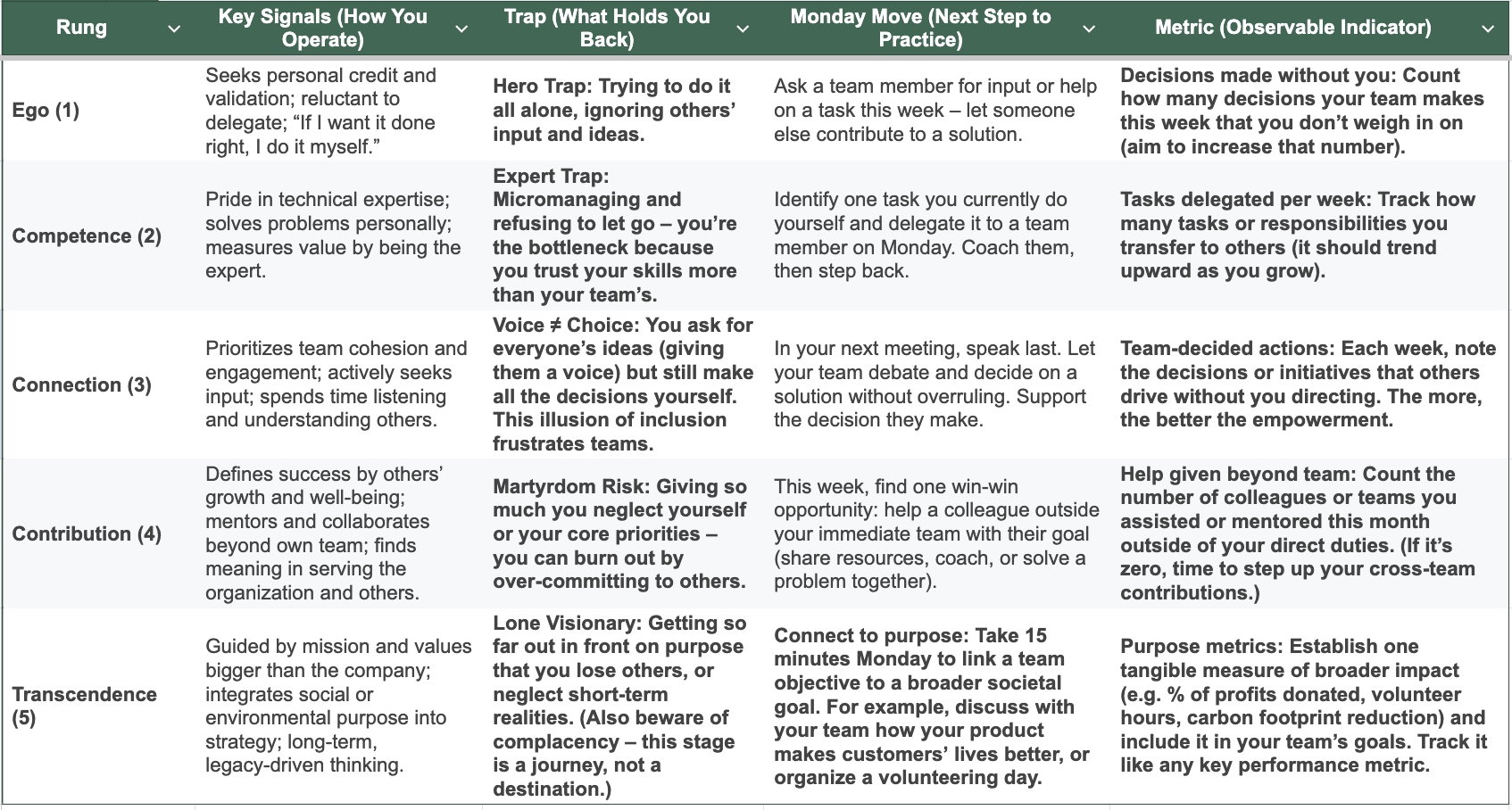
Trap Highlight – Voice vs. Choice: At the Connection stage, beware the “Voice ≠ Choice” pitfall. Giving people a say isn’t the same as giving them real say. If you constantly solicit opinions but never let others call the shots, you’re still holding the reins. To truly empower your team, sometimes you must grant choice – real decision-making authority – not just a voice. A simple rule: if someone else can make a decision, let them.
The Growth Ladder is meant to be used. Each rung comes with a “Monday Move” because climbing the ladder happens through behavior, not just mindset. These are small, concrete actions you can schedule at the start of your week to practice the habits of the next level up. Along with each move is a Monday Metric – a straightforward way to observe the change. Leadership growth can feel abstract; metrics keep it real. For example, an Ego-driven leader might start counting how many decisions their team makes without them. If it’s zero today and five a month from now, that’s tangible progress.
Research backs this progression. As you climb, not only does your team benefit – you benefit too. Take the Contribution rung: leaders who give their time and expertise to help others tend to be happier and more fulfilled. One global study across 136 countries found that people who spent money on others reported greater happiness, in rich and poor nations alike[3][4]. And a meta-analysis of kindness interventions revealed that performing acts of kindness boosts well-being for the giver (albeit by a modest amount)[5]. In other words, doing good helps you feel good.
The key, however, is to practice what organizational psychologist Adam Grant calls “otherish giving” – generosity with discernment. Pouring yourself out for others 24/7 can lead to what Grant terms pathological altruism, where you help to your own detriment. Successful givers balance concern for others with care for themselves. As Grant puts it, “When concern for others is coupled with a healthy dose of concern for the self, givers are less prone to burning out… and they’re better positioned to flourish.”[6] In practical terms, don’t set yourself on fire to keep others warm. Help others and take care of your needs; you’ll sustain your contribution far longer.
Moving to Transcendence, the impact of service expands to society at large. This isn’t just theory—forward-thinking companies are already doing it. In 2022, Patagonia’s founder Yvon Chouinard made headlines by giving away his $3 billion company to fight climate change[7][8]. He transferred ownership to a trust and a nonprofit so that “Earth is now our only shareholder” and all future profits (approximately $100 million a year) go to environmental causes. You don’t need to be a billionaire to apply this principle. As a leader at any level, you can infuse Transcendence into your team or organization. Codify It:
Policy: Bake a broader purpose into your policies or business model. For example, you might commit a percentage of profits to a social or environmental cause (much like Patagonia’s long-running “1% for the Planet” pledge).
Charter: Formalize your team or company’s mission in a charter or values statement that puts service front and center. This could mean becoming a certified B-Corp, adopting a stakeholder covenant, or simply writing down “why we exist” beyond making money.
Compensation: Align incentives with the mission. Tie leadership bonuses or team rewards to metrics like customer impact, community engagement, or sustainability goals – not just short-term revenue. When doing good is literally in the bonus plan, it becomes a sustained priority.
By codifying service in this way, Transcendence becomes systematic. It’s not reliant on one visionary’s passion; it’s built into how the organization operates and how success is measured.
Growth Ladder Diagnostic
Ready to see where you are on the Growth Ladder? The following ten statements will help diagnose your current rung. Score yourself for each statement on a scale from 0–2 (0 = No, not typical for me; 1 = Sometimes; 2 = Yes, often true for me). Be candid – this is for your eyes only:
1. “I prefer to do tasks myself because I’m convinced I’ll do them better (or faster) than others.”
2. “I feel proud of being the go-to expert in most situations at work.”
3. “I actively seek out colleagues’ opinions and ideas before making important decisions.”
4. “I allocate significant time to coaching or training others in my knowledge areas.”
5. “I find myself advocating for my team’s needs and success even if it means putting my own priorities aside.”
6. “I often volunteer for projects or committees that benefit the broader organization, not just my team.”
7. “When making decisions, I consider the impact on people beyond my immediate team (other departments, customers, community).”
8. “I derive a sense of purpose from helping others grow, more than from my personal achievements.”
9. “I have a clear personal mission that is about improving something larger than my company (society, environment, a cause).”
10. “I openly encourage my organization to pursue goals that benefit not only us but also our community or the planet.”
Scoring: Add up your points (maximum 20). This isn’t scientific, but patterns are revealing. In general, if your total is 0–4, your center of gravity is around Rung 1 (Ego) – you’re likely focused on personal achievement and expertise. Scores of 5–8 suggest Rung 2 (Competence), where you’re honing skills but may not be fully leveraging others. 9–12 indicates Rung 3 (Connection) – you value relationships and team input. 13–16 points signal Rung 4 (Contribution), meaning you thrive on developing others and looking beyond yourself. And 17–20 points suggest you’re operating at Rung 5 (Transcendence), driven by purpose and service to a broader mission.
Now, look at the next rung up from where you scored. That’s your growth opportunity. For example, if you scored 10 (Connection), your next target is Contribution. Go back to the table and find the Monday Move for that next rung – that’s your action item for the coming week. Growth is ladder-like: one rung at a time.
Team Diagnostic: You can apply the Growth Ladder lens to your whole team or organization, too. Here are simple metrics at three levels:- Individual Contributors: Collaboration Index – e.g., how many cross-team or peer-to-peer assists has each person made this quarter? (A higher number suggests growth beyond ego and competence.)- Managers: Delegation Rate – what percentage of key decisions or tasks do managers delegate to their team versus doing themselves? (Healthy management at Connection and Contribution levels will delegate more as teams develop.)- Executives: Purpose Alignment – track one metric of societal or long-term impact (customer NPS, community investment, innovation for future growth) in your strategic scorecard. Are top leaders accountable for something beyond quarterly profits?
From Monday Moves to Lasting Habits
Insight alone doesn’t drive change—habits do. To climb the ladder, commit to a simple ritual: schedule 15 minutes on your calendar each week for your “Monday Move.” Treat it like any important meeting. When Monday 9:00am (or whatever time you choose) comes, use that slot to take action on your growth step (delegate that task, write those thank-you notes, reach out to that mentor/mentee, etc.). Keep a log of these weekly moves, even if it’s just a tally or a sentence in a notebook. At week’s end, reflect for a few minutes: What happened when you acted differently? What can you learn from it? This implementation-intention technique—plan it, do it, review it—will turn one-off actions into new leadership habits.
Over time, small moves compound into transformed leadership. Just ask our overwhelmed VP from the beginning. He started by blocking 15 minutes every Monday to prioritize what not to do himself. He began delegating one meeting or decision a week and coaching a team member to step up. Three months later, he has 30% fewer meetings on his calendar, yet his team is delivering projects faster and with more ownership. Employee engagement on his team jumped in the latest survey. Most importantly, he’s no longer firefighting 12 hours a day—he’s spending time on strategy and mentoring, and his stress levels are down. In short, he became the leader his new role needed. Climb one rung, and your world gets larger — and so do your results.
[1] Startling Remote Work Burnout Statistics (2025) | Apollo Technical
https://www.apollotechnical.com/remote-work-burnout-statistics/
[2] Vertical Development: The Intersection of Change and Leadership – P5
https://changemanagementreview.com/vertical-development-the-intersection-of-change-and-leadership-5/
[3] [4] Prosocial spending and well-being: cross-cultural evidence for a psychological universal - PubMed
https://pubmed.ncbi.nlm.nih.gov/23421360/
[5] A range of kindness activities boost happiness - PubMed
https://pubmed.ncbi.nlm.nih.gov/29702043/
[6] Selfish, Selfless, and Otherish Givers—and Which You Want to be
https://www.build-better.io/p/selfless-selfish-otherish-giving
[7] [8] Patagonia’s billionaire owner gives away company to fight climate crisis | US news | The Guardian